
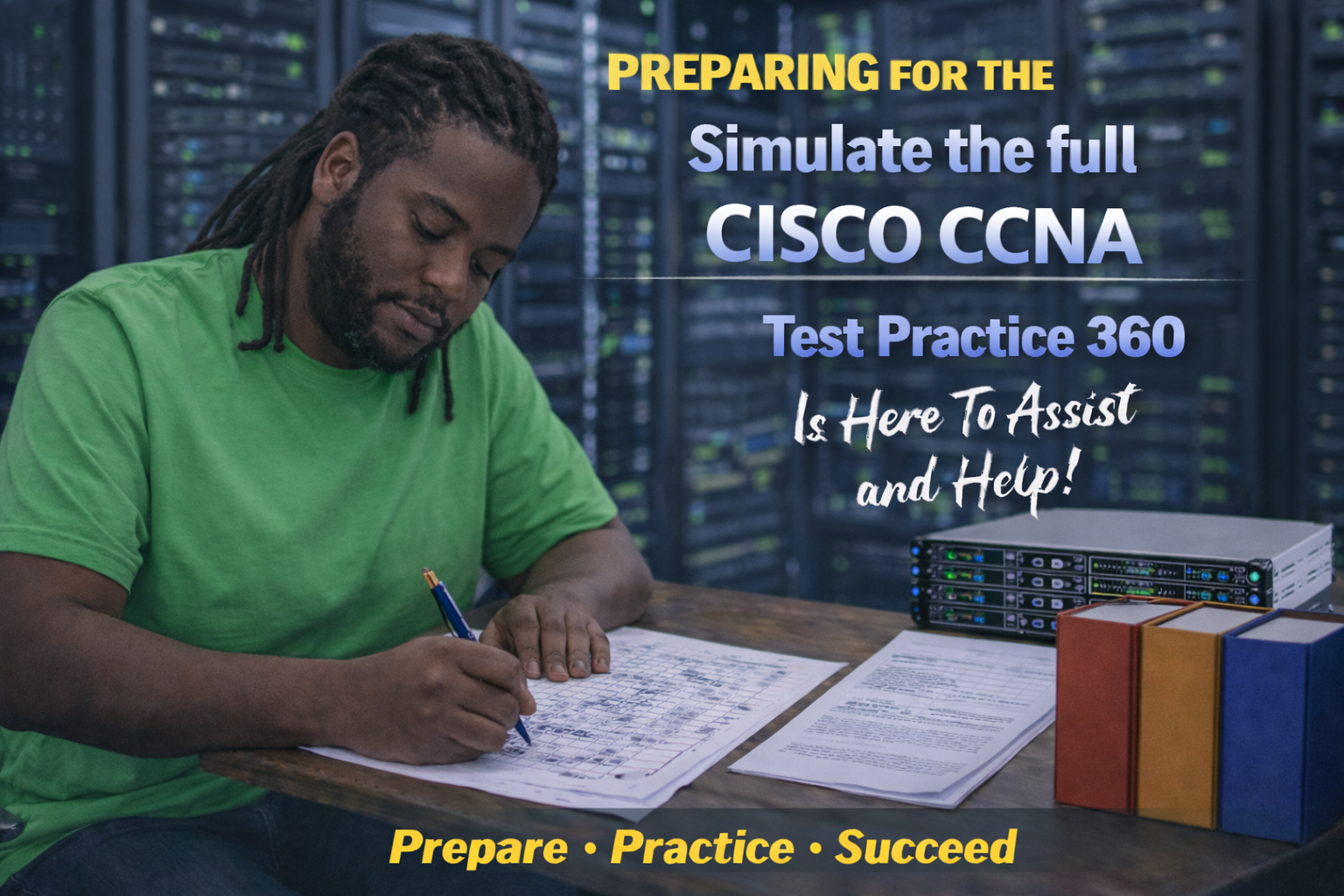
Course objectives
[wpecpp name=”CCNA Cisco Practice Test and Study Guide” price=”7.00″ align=”center”] CCNA Cisco Certification Exam The...
Course structure
CCNA Cisco Certification Exam
The Cisco Systems CCNA certification validates foundational knowledge in networking, security, and infrastructure. The current exam is 200-301 CCNA, which earns the Cisco Certified Network Associate credential.
What the Exam Covers
The test measures entry-level networking skills across five main domains:
- Network Fundamentals
- OSI and TCP/IP models
- IP addressing and subnetting
- Ethernet concepts and cabling
- Network Access
- VLANs and trunking
- Switching concepts
- Wireless fundamentals
- IP Connectivity
- Routing fundamentals
- Static and dynamic routing basics
- Router configuration
- IP Services
- DNS, DHCP, NTP
- SNMP and syslog
- Basic QoS concepts
- Security Fundamentals & Automation
- Access control lists
- Basic firewall and security concepts
- Intro to automation and programmability
Exam Format
- One exam: 200-301
- Multiple-choice, drag-and-drop, and simulation questions
- Approx. 120 minutes
- Scored on a scale of 300 to 1000
- Passing score typically around 825, though Cisco does not publish exact cutoffs
Difficulty Level
CCNA is considered entry-level but technical. The most challenging areas are:
- Subnetting calculations
- Routing logic
- Command-line configuration
- Troubleshooting scenarios
This is not a theory-only exam. You must understand how networks actually function.
Who It’s For
- Network support technicians
- IT help desk professionals
- Entry-level network engineers
- Anyone entering cybersecurity or cloud networking
Bottom Line
The CCNA proves you understand how networks communicate, how routers and switches operate, and how to secure basic infrastructure. It is a strong foundational certification for building a career in IT networking, cybersecurity, or infrastructure engineering.
